

Improving indoor air quality does not always require replacing ductwork, installing a new furnace, or investing in a major ventilation project. Many homes can benefit from smaller tools that address particles, humidity, gases, and common indoor pollutants more directly. The best results usually come from combining filtration with source control and good ventilation. With the right equipment and habits, homeowners can make meaningful improvements without turning air quality into a major renovation project.
Start With a Portable Air Cleaner
A portable air cleaner is one of the most practical tools for reducing airborne particles in a specific room. Models equipped with high-efficiency particulate air, or HEPA, filters can capture fine particles suspended in the air. Portable units can be especially useful in bedrooms, home offices, and other spaces where people spend significant amounts of time.
Choosing the right size matters. Clean air delivery rate, or CADR, indicates how much filtered air a unit can provide. A higher CADR generally means the cleaner can serve a larger room or remove particles more quickly. Selecting a unit with a CADR appropriate for the room is more useful than simply choosing the smallest or quietest model available.
For households concerned about odors or certain gases, look for a unit that combines particle filtration with activated carbon or another adsorbent material. Particle filters and gas filters perform different jobs, so a HEPA filter alone should not be expected to remove every type of indoor pollutant.
Upgrade the Existing HVAC Filter When Possible
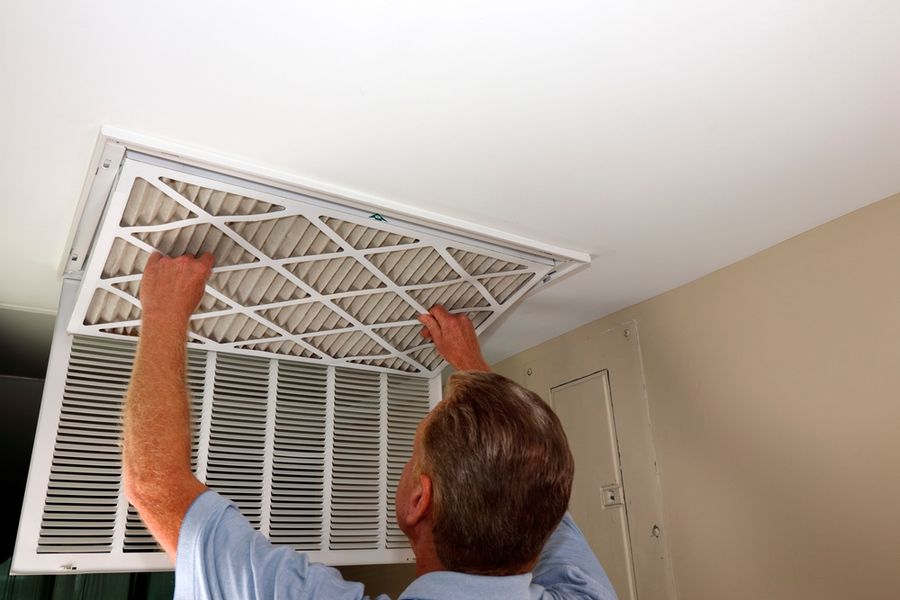
Improving filtration does not necessarily require replacing the HVAC system. In homes with forced-air heating or cooling, upgrading the existing filter can help reduce particles as air circulates through the system.
A MERV 13 filter is often recommended when the equipment can accommodate it, although some systems are not designed for filters with that level of resistance. Homeowners should check the equipment specifications or consult a qualified technician before installing a substantially different filter.
Filter maintenance is equally important. A heavily loaded filter cannot perform properly and may restrict airflow. Replacement frequency depends on the type of filter, household conditions, pets, pollutant levels, and how frequently the HVAC system operates, so following the manufacturer's instructions is preferable to relying on a universal schedule.
Use a Humidity Meter to Identify Moisture Problems
Indoor air quality is affected by more than airborne dust. Excess moisture can encourage mold growth and create conditions that support other unwanted biological contaminants.
A simple digital hygrometer can show the relative humidity inside a room. Indoor humidity is generally best kept between about 30% and 50%, with persistent levels above that range potentially signaling a need for better moisture control.
Because these meters are compact, homeowners can move them between rooms to identify problem areas. Bathrooms, basements, laundry rooms, and bedrooms may show very different readings. Monitoring several spaces can help determine whether moisture is a localized problem or something affecting much of the house.
Add a Dehumidifier Where Moisture Stays High
When humidity remains elevated, a portable dehumidifier can be more useful than attempting a major HVAC modification. These appliances remove water from indoor air and can be particularly useful in basements or other damp spaces.
A dehumidifier should not be treated as a solution for an active plumbing leak, foundation problem, or ongoing water intrusion. Moisture sources should be corrected whenever possible. The appliance can then help control the remaining humidity rather than continually compensating for an unresolved problem.
Maintenance matters here too. Water reservoirs need regular emptying unless the unit drains automatically, and filters or intake areas should be cleaned according to the manufacturer's directions. A neglected dehumidifier can become less efficient and harder to keep clean.
Consider an Indoor Air Quality Monitor
Consumer indoor air quality monitors can provide information about conditions that are otherwise difficult to notice. Depending on the model, they may track fine particulate matter, carbon dioxide, volatile organic compounds, temperature, or humidity.
These devices are most useful for identifying patterns rather than diagnosing every pollutant in the home. A monitor might reveal that particle levels rise sharply during cooking, for example, or that carbon dioxide increases in a closed bedroom overnight. That information can help homeowners decide when filtration, ventilation, or another change may be useful.
Readings should also be interpreted cautiously. Consumer sensors vary considerably in accuracy, and a general air quality monitor is not a substitute for a dedicated safety detector or professional testing when a serious hazard is suspected.
Install Dedicated Carbon Monoxide Detectors
Some indoor air hazards deserve their own specialized equipment. Carbon monoxide is colorless and odorless, so it cannot be reliably detected without an alarm.
Homes with fuel-burning appliances, fireplaces, or attached garages should have appropriate carbon monoxide alarms installed according to current safety guidance and the manufacturer's placement instructions. Unlike general-purpose air quality monitors, these devices are designed specifically to warn occupants when dangerous carbon monoxide levels are detected.
Carbon monoxide alarms also need ongoing attention. Batteries, power supplies, and the alarms themselves have finite service lives, making routine testing and timely replacement essential.
Improve Kitchen Ventilation at the Source
Cooking can generate particles, moisture, odors, and gases, making the kitchen an important place to address indoor air quality. A range hood that exhausts outdoors can remove pollutants closer to where they are produced rather than relying entirely on whole-room filtration afterward.
When outdoor-venting equipment is available, use it consistently while cooking. If the home has only a recirculating hood, keeping its filters clean can help it operate as intended, although recirculating systems do not provide the same outdoor ventilation.
Opening a window may also help when outdoor conditions are suitable. Source control and clean outdoor ventilation remain important parts of improving indoor air quality, even when filtration equipment is being used.
Build a Layered Air Quality Strategy
No single device can remove every indoor pollutant. Portable air cleaners are useful for particles, activated carbon can address some gases and odors, dehumidifiers can manage excess moisture, and dedicated alarms can detect specific safety hazards. Combining the appropriate tools produces a more complete approach than expecting one machine to solve every problem.
Just as important, equipment works best when paired with basic source control. Fix moisture problems, reduce unnecessary pollutant sources, ventilate when outdoor air is clean, and maintain filters and appliances regularly. These smaller measures can significantly improve how indoor air is managed without requiring a major HVAC overhaul.
Better Air Does Not Require a Complete Remodel
Improving indoor air quality can begin with relatively straightforward changes. A correctly sized portable air cleaner, an appropriate HVAC filter, a humidity meter, a dehumidifier, and dedicated safety detectors can each address a different part of the problem.
The most effective approach is to identify what is actually affecting the home and choose tools accordingly. With several well-targeted measures working together, homeowners can improve indoor conditions while leaving the existing HVAC system largely intact.