

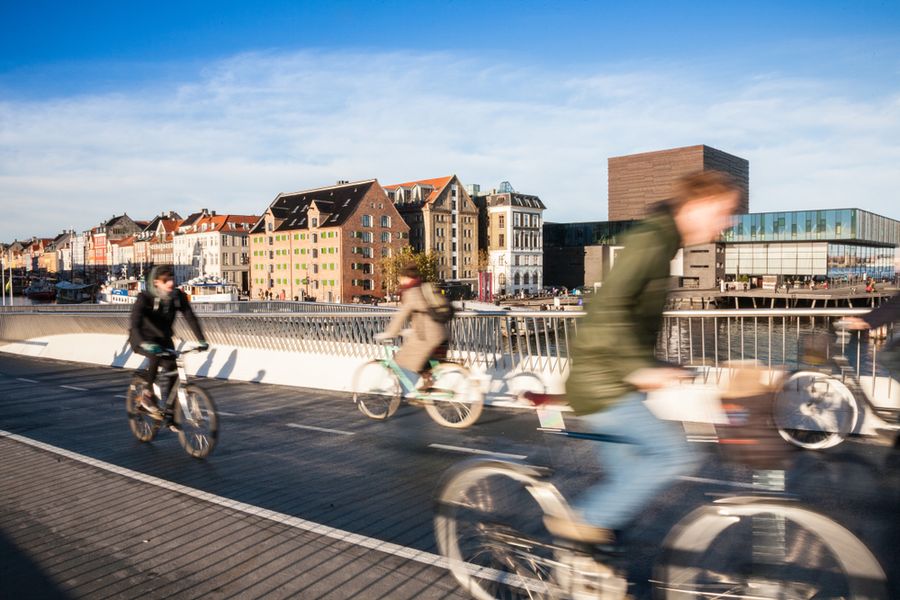
Copenhagen is unusually easy to explore without renting a car. Its neighborhoods are connected by an extensive network of cycle tracks, Metro lines, trains, buses, and harbor buses, making it practical to move between waterfront districts, residential areas, parks, and cultural attractions throughout the day. The best approach is often to combine transportation methods: ride a bike when the weather is good, use transit for longer distances, and navigate individual neighborhoods on foot once you arrive.
Get Comfortable With the City's Transportation Network
Copenhagen has hundreds of kilometers of cycle tracks and more than 25 bicycle and pedestrian bridges, giving cyclists direct connections across much of the city. Visitors can also combine cycling with public transportation. Bicycles are allowed on S-trains at no additional charge, while Metro and harbor bus trips with a bicycle generally require a bike ticket and have some rush-hour restrictions.
Public transportation is equally useful when you want to cover more ground. Copenhagen's Metro operates around the clock, while buses, trains, and harbor buses fill in connections throughout the city. The same valid zone-based ticket can generally be used across Metro, buses, trains, and harbor buses.
Explore Nørrebro by Bike
Nørrebro is one of the easiest neighborhoods to appreciate from a bicycle because its appeal is spread across busy main streets, small side streets, parks, cafés, and residential blocks. Nørrebrogade forms a major spine through the district, while quieter streets branch away toward local shops and green spaces.
Cycling also makes it easy to connect Nørrebro with the lakes and neighboring Frederiksberg. The area is widely recommended for bicycle exploration, and its dense street pattern means you can cover much more than you would on a short walk. If cycling feels intimidating during rush hour, use the Metro to reach the neighborhood and explore more slowly on foot.
Combine Christianshavn With Refshaleøen
Christianshavn is particularly well suited to car-free sightseeing. The neighborhood's canals, bridges, historic streets, and waterfront paths are easy to navigate on foot or by bicycle, and the Metro provides a straightforward connection from other parts of the city.
From there, continue by bike toward Refshaleøen, a former industrial area that has developed into a destination for food, cultural spaces, and waterfront activity. This combination works especially well because the journey itself becomes part of the experience: you move from historic canal streets into a much more open, industrial harbor landscape. Christianshavn is specifically noted as an area that lends itself to cycling, walking, and waterside exploration.
A harbor bus can provide another way to travel along the waterfront while giving your legs a break. Since harbor buses are part of the regular public transportation system, they can be integrated into the same day rather than treated as a separate sightseeing cruise.
Pair Vesterbro With Frederiksberg
Vesterbro sits immediately west of Copenhagen's historic center and is easy to reach from Central Station. It is compact enough for walking, but a bicycle helps if you want to move between the Meatpacking District, quieter residential streets, and neighboring Frederiksberg without repeatedly backtracking.
Frederiksberg offers a noticeably different atmosphere, with broad avenues, parks, cultural sites, and residential areas. Cycling routes through the district are specifically designed around architecture, green spaces, and family-friendly attractions. Metro stations throughout Frederiksberg also make it simple to return to central Copenhagen without retracing the ride.
These two areas make a useful pairing because they provide contrasting sides of the city within a relatively compact area: lively urban streets in Vesterbro followed by greener, quieter surroundings in Frederiksberg.
Ride Through Østerbro and Continue to Nordhavn
Østerbro is a strong choice for visitors who prefer parks, residential streets, waterfront access, and a calmer pace. The district stretches from the Copenhagen Lakes toward the coast and includes large green spaces such as Fælledparken.
Cycling north from Østerbro leads naturally toward Nordhavn, where old port infrastructure sits alongside newer waterfront development. Dedicated self-guided routes connect the two districts and highlight parks, residential neighborhoods, harbor areas, and contemporary urban design.
The Metro is especially useful here if you want to ride only one direction. You can explore outward by bike, then use public transportation for the return trip rather than repeating the same route.
Use Amager for Beaches, Nature, and Modern Architecture
Amager offers some of Copenhagen's best opportunities to combine city cycling with larger open spaces. Depending on the route, visitors can reach Islands Brygge, Amager Beach Park, Ørestad, and nature areas farther south.
The island has extensive cycling routes through residential districts, waterfront areas, green spaces, and newer architectural developments. Amager Beach Park is also reachable by Metro, which makes it easy to design a trip that combines cycling in one direction with transit in the other.
For travelers who want a break from dense city streets, Amager is particularly useful because it offers more open landscapes without requiring a car or a lengthy journey outside Copenhagen.
Let the Neighborhood Determine the Transportation
The easiest way to see Copenhagen without a car is not to choose between biking and transit, but to use each where it works best. Ride between nearby neighborhoods when the weather is favorable, take the Metro or S-train for longer jumps, and use harbor buses when traveling along the waterfront.
Nørrebro rewards slow cycling through its side streets, Christianshavn and Refshaleøen work well as a waterfront route, Frederiksberg offers green and architectural rides, Østerbro connects naturally with Nordhavn, and Amager opens the door to beaches and nature. With those areas linked by reliable transit and extensive bicycle infrastructure, a car is more likely to complicate a Copenhagen visit than improve it.