

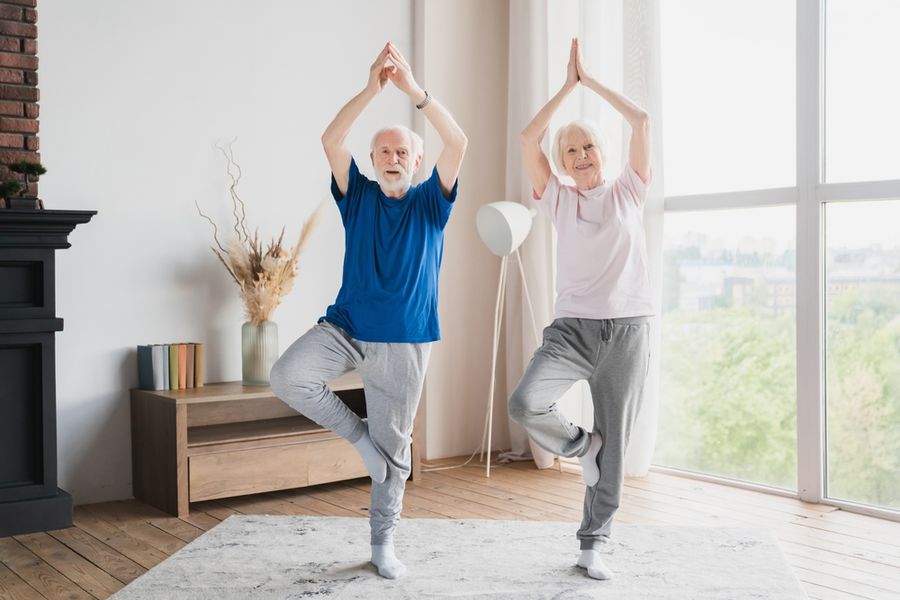
Balance plays an important role in walking, climbing stairs, getting out of a chair, and recovering from a small misstep. As people get older, maintaining balance and lower-body strength can become increasingly important for reducing fall risk. Fortunately, useful exercises can be performed at home without complicated equipment. Several movements that focus on stability, leg strength, coordination, and controlled weight shifting can support safer everyday movement.
1. Single-Leg Stands
Standing on one leg is one of the simplest ways to challenge balance because it reduces the body's base of support. It is also commonly included in balance-training guidance for older adults.
Stand beside a sturdy counter or heavy chair and place one or both hands on it as needed. Slowly lift one foot a few inches from the floor while keeping your body upright. Hold the position briefly, lower the foot, and repeat on the other side.
Beginners should prioritize stability rather than trying to hold the position for a long time. As the exercise becomes easier, gradually use less hand support or extend the duration. Avoid practicing beside lightweight furniture that could move if grabbed suddenly.
2. Heel-to-Toe Walking
Heel-to-toe walking creates a narrow base of support, requiring greater control than ordinary walking. This type of movement is often recommended as a simple home balance exercise.
Choose a clear walking path near a wall or countertop. Place one foot directly in front of the other so the heel of the front foot nearly touches the toes of the back foot. Continue forward slowly, keeping your eyes ahead instead of looking down continuously.
The goal is controlled movement, not speed. Start with only a few steps if necessary. People who feel unsteady can keep a hand near a wall or other stable support. Over time, increasing the number of controlled steps can provide an additional challenge.
3. Sit-to-Stand Exercises
Being able to rise confidently from a chair is important for daily independence, and the motion also strengthens muscles used in standing and walking. Sit-to-stand movements are included among exercises that can support strength and fall prevention.
Begin in a sturdy chair that will not slide. Place both feet flat on the floor and slightly apart. Lean forward enough to bring your weight over your feet, then stand using a slow, controlled motion. Sit back down with the same control instead of dropping into the chair.
Use the armrests or another stable support if needed. As strength improves, try relying less on the hands. Difficulty can also be increased gradually by completing additional repetitions, provided good form is maintained.
This exercise has the added benefit of closely resembling a movement used repeatedly throughout daily life, making the strength gained particularly practical.
4. Standing Heel Raises
Strong lower legs and ankles help control the body during walking and standing. Heel raises target the calf and ankle muscles while also requiring some balance.
Stand behind a sturdy chair or at a countertop with your feet approximately hip-width apart. Slowly lift both heels so your weight moves toward the balls of your feet. Pause briefly at the top, then lower the heels back to the floor with control.
Using a solid support while performing heel raises is recommended, particularly when first learning the movement. As balance improves, you may be able to reduce how much pressure you place through your hands.
Avoid bouncing quickly through repetitions. Moving slowly makes it easier to maintain control and recognize whether one side feels significantly weaker than the other.
5. Controlled Side Steps
Everyday movement does not happen exclusively forward and backward. Stepping sideways requires the hips and legs to stabilize the body in a different direction, which makes lateral movement useful for a more complete balance routine.
Stand near a kitchen counter or another long, stable surface. Step one foot sideways, then bring the opposite foot toward it without crossing your legs. Continue for several steps in one direction before returning the other way. Keep your knees slightly relaxed and your toes pointed generally forward.
Start with your feet together and knees slightly bent, then step sideways slowly with one foot before bringing the other foot across to join it. Keep the movement controlled and avoid letting your hips drop as you step. Beginners can practice near a wall or stable chair for extra security and gradually increase the number of repetitions as the exercise becomes more comfortable
Because sideways movement may be less familiar than ordinary walking, perform this exercise slowly and make sure the floor is clear before beginning.
Make Balance Training Safe and Progressive
Balance exercises should provide a challenge without creating an unnecessary fall hazard. A countertop, wall, or sturdy chair can provide support while skills develop. Exercise programs aimed at reducing fall risk are most effective when they challenge balance progressively rather than remaining at exactly the same difficulty level.
Progress can be modest. You might hold a single-leg stand a little longer, complete additional heel-to-toe steps, use slightly less hand support, or add repetitions to sit-to-stands.
Anyone who experiences pain, dizziness, unusual shortness of breath, repeated falls, or significant instability should stop and seek appropriate medical guidance before continuing. People with medical conditions or substantial balance problems may also benefit from individualized instruction.
Build Better Balance One Exercise at a Time
Improving balance at home does not require complicated routines or specialized machines. Single-leg stands, heel-to-toe walking, sit-to-stands, heel raises, and controlled side steps each challenge a different part of stability and movement.
The most useful approach is to practice consistently while increasing difficulty gradually and safely. Combining balance work with lower-body strengthening can make everyday movements feel more controlled and help support greater confidence around the home. Small improvements in strength, coordination, and stability can add up to meaningful progress over time.