

Switzerland is one of the easiest countries in Europe to explore primarily by rail, and a first trip can connect major cities, mountain towns, lakes, and Alpine scenery without renting a car. The challenge is choosing among dozens of scenic routes. A good introductory itinerary should combine famous panoramic journeys with practical intercity connections, allowing enough time to stop along the way. The top routes provide a strong foundation for seeing several distinct sides of Switzerland by train.
Lucerne to Interlaken: An Easy Scenic Introduction
The Lucerne–Interlaken Express is an excellent starting point because it connects two popular bases while delivering impressive scenery without requiring an all-day commitment. The journey takes about 1 hour and 50 minutes and passes lakes, villages, waterfalls, and Alpine landscapes between Lucerne and Interlaken Ost.
Trains normally operate hourly, making the route easy to incorporate into a broader itinerary. Travelers can also get off at intermediate stops such as Brienz or Lungern and continue on a later service. Seat reservations are available on the main panoramic service but are not required simply to travel the route.
Once in Interlaken, travelers have convenient connections toward destinations in the Bernese Oberland, making this route useful both as a scenic ride and as transportation between two logical stops.
Interlaken to Montreux: Cross the Country on the GoldenPass Route
Continuing west from Interlaken toward Montreux creates one of Switzerland's most appealing cross-country rail journeys. The GoldenPass corridor moves from the Bernese Oberland through chalet-filled landscapes toward Lake Geneva and French-speaking Switzerland.
The GoldenPass experience traditionally connects Interlaken, Zweisimmen, and Montreux, while the GoldenPass Express provides direct services between Interlaken and Montreux on selected departures. The broader route is designed to showcase the changing landscapes and cultures between German- and French-speaking regions.
Montreux also makes a useful stop rather than merely an endpoint. Visitors can spend time along Lake Geneva, explore nearby towns, or continue by conventional train toward Lausanne or Geneva.
Zermatt to St. Moritz: Take the Glacier Express Across the Alps
For travelers who want one major panoramic train experience, the Glacier Express is difficult to overlook. Its full route connects Zermatt and St. Moritz in roughly eight hours, passing through Brig, Andermatt, Chur, and several smaller Alpine communities.
The length of the trip makes it better suited to travelers who enjoy the journey itself rather than those trying to move quickly between destinations. Shorter sections are possible, so it is not necessary to ride the entire route. A first-time visitor could, for example, incorporate the Andermatt-to-St. Moritz portion into a longer itinerary.
Unlike ordinary Swiss rail services, the Glacier Express requires a seat reservation in addition to a valid ticket. Because reservations can fill during popular travel periods, this is one route worth organizing before the rest of the day's plans are finalized.
St. Moritz to Tirano: Cross the Bernina Pass
The Bernina route provides a dramatic contrast to the Glacier Express. From the Engadin region around St. Moritz, trains climb through high Alpine landscapes before descending through Valposchiavo toward Tirano in northern Italy.
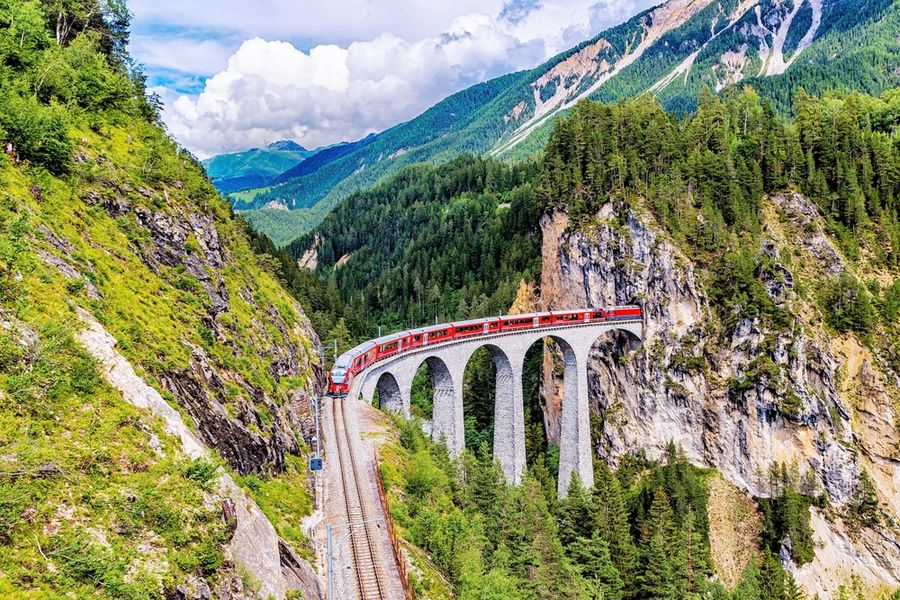
The Bernina Express travels over the UNESCO-listed Rhaetian Railway route, crossing famous structures such as the Landwasser Viaduct and continuing past glaciers, mountain lakes, and the Bernina Pass before reaching a much milder landscape near Tirano.
Travelers have more than one way to experience the line. The panoramic Bernina Express uses reserved seating, while regional trains travel the same railway and offer greater flexibility. Reservations on regional trains are optional, although they are recommended during busy periods.
Lucerne to Lugano: Combine Rail and Lake Travel
Travelers interested in central and southern Switzerland can use the historic Gotthard corridor to connect Lucerne with Ticino. The Gotthard Panorama Express combines a boat journey across Lake Lucerne with a train ride from Flüelen through the historic Gotthard route toward Bellinzona and Lugano.
This route offers a particularly noticeable change in atmosphere. The trip begins amid the lakes and mountains of central Switzerland and ends in Italian-speaking Ticino, where architecture, vegetation, and food reflect influences from across the nearby Italian border.
The dedicated panoramic service operates seasonally rather than year-round, so travelers should check the schedule for their dates. Conventional trains also provide connections through the region when the panoramic service is unavailable.
Use Regular Trains to Connect the Scenic Routes
Switzerland's panoramic trains receive much of the attention, but ordinary services are what make a rail-based itinerary practical. A first trip might begin in Zurich, continue to Lucerne, cross to Interlaken and Montreux, travel onward toward Zermatt, then use the Glacier and Bernina routes to finish in eastern Switzerland or northern Italy.
There is no need to include every panoramic train in one vacation. Spending additional nights in places such as Lucerne, Interlaken, Zermatt, or St. Moritz usually produces a more enjoyable itinerary than treating the country as one continuous train ride.
Build the Trip Around Destinations, Not Just Trains
Switzerland's rail system makes it tempting to collect famous train journeys, but the strongest first itinerary uses those routes to connect places worth exploring in their own right. The Lucerne–Interlaken Express provides an accessible introduction, the GoldenPass corridor connects contrasting regions, and the Glacier and Bernina routes deliver the most dramatic Alpine scenery.
Choose two or three scenic routes that fit naturally between the destinations you most want to visit, then use Switzerland's regular trains to fill the gaps. That approach preserves the pleasure of rail travel without allowing transportation to consume the entire trip.